
The floodlights are warming above the boundary as a batter settles into position. A red ball has just left the bowler’s hand. In the space of a few seconds, the crowd leans forward, the field closes around a patch of grass and an ordinary evening feels full of possibility.
This is an imagined scene. The adult cricketer in the accompanying illustration is fictional, and the image does not portray a real player, ground or match. It gives this Refuel feature a way to consider the sights and rhythms that make cricket compelling to follow.
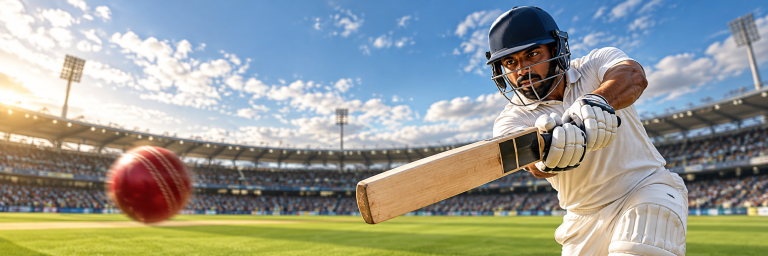
The moment before the ball arrives
The illustration holds the batter and the red ball in a wide view of an imagined ground. Beyond the figure, the stands and sky give the scene its scale. The ball is suspended in flight, leaving the moment open rather than showing what happens next.
In the imagined match beyond the picture, a captain might arrange fielders near the bat or farther toward the boundary. Their positions would change the shape of the field. The illustration itself focuses on the batter’s helmet, gloves and bat rather than showing that wider arrangement.
The image captures an imagined instant rather than an outcome. It leaves the ball in flight and the batter poised to meet it. There is no score, team badge or named opposition to turn the scene into a record of an actual contest.
A ground has its own pace
A cricket ground can feel different as daylight fades. The grass keeps some of the afternoon’s colour while the stands grow darker. Under the lamps, the red ball and pale clothing stand out sharply. Sound travels unevenly: an appeal may reach one part of the crowd before a reaction spreads across another.
Between deliveries, there is time to notice the setting. A fielder walks a few paces to one side. The batter looks toward a partner. Someone beyond the boundary returns a ball. These small movements give shape to the pauses that separate one moment of action from the next.
The rhythm also depends on the form of the match. A long contest gives a session room to develop over hours. A shorter match places a different frame around an innings. In either case, a single image can suggest the atmosphere without explaining everything that happened around it.
Following a changing innings
Imagine two adult batters beginning a partnership while the light changes over the stands. One sends the ball into open space and the pair add runs. Later, a fielder stops another shot before it reaches the boundary. The scoreboard moves, but the sound and movement on the field give those numbers a human scale.
A partnership belongs to the period in which those two batters are together. The team total belongs to the innings as a whole. A scorecard can place the two alongside each other, while a match report can describe the passage of play that connected them.
In our fictional evening, a wicket eventually ends the partnership. The field rearranges as a new batter arrives. Nothing about the previous passage guarantees what the next delivery will bring. The interest lies in watching the situation change, one recorded event at a time.
The illustration offers no result for this imagined innings. It is a visual companion to the scene, not evidence of a fixture or a prediction about a player. Actual teams, scores and schedules need their own current, identifiable sources.
What a score leaves out
A scorecard is useful because it keeps a concise record. Runs, wickets and overs tell readers where an innings stands. The numbers alone cannot reproduce the pause before an appeal, the angle of a boundary shot or the way a crowd reacts when a close chance passes.
A description of those details adds texture without changing the result. A batter’s timing may be striking; a bowler’s spell may shift the mood of a session. Such observations are tied to what a reporter or spectator has actually seen. They are different from a promise about what will happen next.
Context matters for another reason. A total has meaning within an innings and a match format. A figure from one contest should not be treated as the position in another. For a real event, the teams, competition and relevant scorecard identify the record being discussed.
Cricket and the Refuel collection
The source listing for Refuel names cricket alongside casino games, live casino and slots. This publication’s cricket feature uses an imagined ground to explore the sport’s atmosphere. It does not establish that a particular match, market or transaction is available through this site.
Cricket’s deliveries, overs and innings have their own record. A card table and a slot display follow different sequences. Bringing them into the same collection gives readers different subjects to explore while leaving each subject’s identity intact.
Back at the imagined ground, the field is ready again and the ball is on its way. The picture holds that instant open: an adult batter, a changing sky and a crowd waiting to see where the next shot will go.